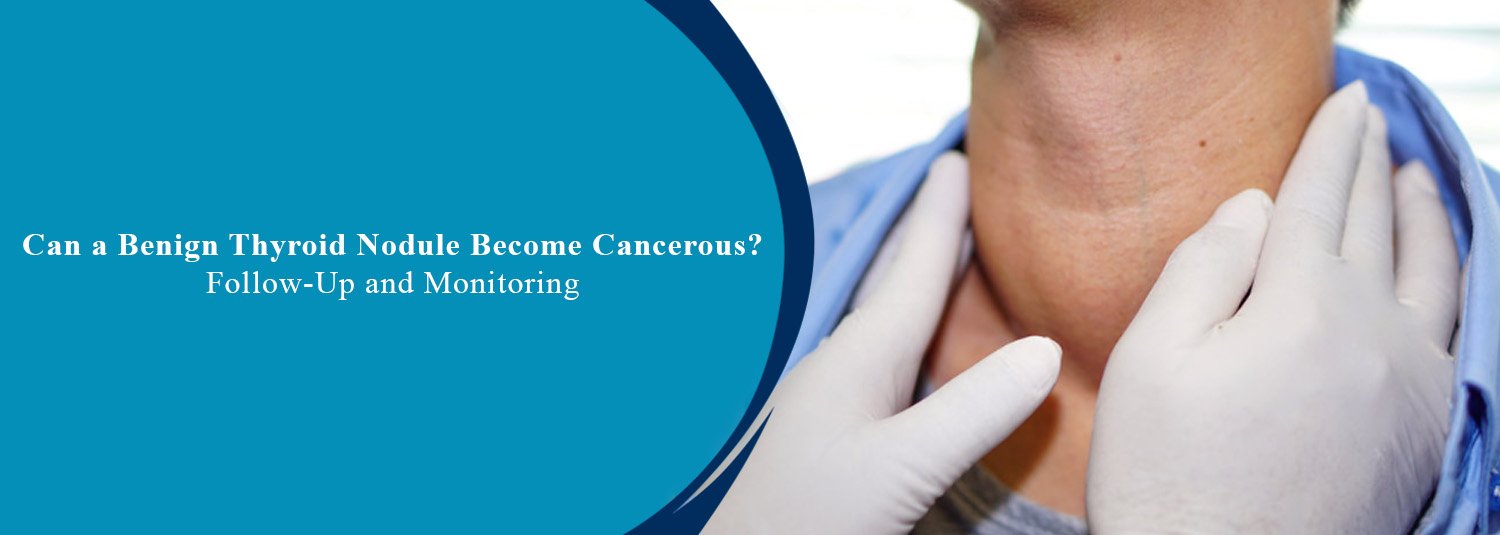
Thyroid nodules are lumps or abnormal growths within the thyroid gland, which is located at the front of the neck, below the thyroid cartilage and around the upper part of the windpipe. They are widely seen, and most of them are not malignant, i.e., are not cancer. A benign thyroid nodule is usually safe, but eventually, it is sometimes unknown whether it will grow and develop into cancer. However, benign thyroid nodules do not start to develop into cancer. Non-cancerous biopsies sometimes fail to detect an abnormal area, and that is why it is important to follow up. Periodic follow-up tests enable doctors to detect any changes in the nodule and determine if additional tests are needed. With Dr Nikunj Jain (Co-Founder & Head of Nuclear Medicine), patients will learn the importance of proper thyroid investigation and how nuclear medicine will help them in selected thyroid ailments. What Is a Benign Thyroid Nodule? A thyroid nodule is defined as an abnormal mass of tissue in the thyroid gland. Can take the solid, liquid or a combination of both. Nodules may form as a result of thyroid changes, inflammation, lack of iodine, or other factors. The overwhelming majority of thyroid nodules are harmless and don't exhibit any symptoms. They are almost always found at a physical examination or when having another type of diagnostic test. Doctors can use its size, the way it looks on an ultrasound, and information about the patient's medical history to decide what further tests a patient needs following diagnosis. Can a Benign Thyroid Nodule Become Cancerous? Typically, thyroid nodules are not cancer and don't become thyroid cancer. But a nodule that comes back as a benign biopsy does not guarantee that the nodule won't be a problem in the future. In some cases, there may not be sufficient cells from the nodule to be sampled in the biopsy, or a small abnormal area within the nodule may not be sampled. This sometimes results, in which case, the report states that the nodule is benign, when it is in fact not. A nodule can change over a period of time, or a new nodule may form in the thyroid gland. Changes in the size or ultrasound appearance of a thyroid nodule do not automatically indicate cancer but may require further clinical assessment, it does not indicate that the original nodule likely has turned into a cancer. They just mean that there is some need for more clinical evaluation. Thyroid cancer risk is related to ultrasound characteristics, biopsy results, family history, and previous radiation exposures to the head/neck area. Signs That a Thyroid Nodule Needs Further Evaluation Many benign thyroid nodules don't show symptoms and aren't a cause for concern. But some changes should not be ignored. If the size of the thyroid lump increases, the pain persists in the neck, or difficulties in swallowing or breathing become noticeable, it may need medical attention. Other conditions that should be discussed with the doctor include an ongoing cough and a voice that changes in some unknown way. In some early stages, a thyroid cancer may not be noticeable. So, it's not because a patient is not experiencing any pain or discomfort, does not rule out a problem. It takes into account findings during a doctor's examination and the report before making a decision as to whether more tests are needed. How Are Benign Thyroid Nodules Monitored? The follow-up schedule is tailored to the size of the nodule, the appearance of the nodule on ultrasound, the nodule biopsy results, and the patient's medical history. Thyroid ultrasound is recommended to track changes occurring in the nodule, as needed, by physicians. The assessment of its size, shape, composition, margins, and internal features is done with the help of ultrasound. Some characteristics, such as irregular margins, small calcifications, or a height greater than the width of the tumor, or certain appearance of solid and/or hypoechoic regions of the tumor, could raise suspicion and affect the need for further evaluation. Not all nodules need frequent ultrasound evaluations. If a nodule is found that has reassuring features, it may not be necessary to monitor it as often as nodules with suspicious features might need to be monitored more closely. An additional fine-needle aspiration (FNA) biopsy might be suggested if the ultrasound examination shows features that are suspicious, the nodule grows significantly, or if there is any concern about the biopsy result of the initial procedure. Just being bigger doesn't mean cancer. Tests Used to Evaluate Thyroid Nodules The investigations performed will depend upon a patient's symptoms and initial findings.
Thyroid Ultrasound: An imaging study that results in a picture that shows the structure and appearance of thyroid nodules. It assists physicians in determining their characteristics and whether a biopsy is necessary.
Fine-Needle Aspiration (FNA): A needle is used to remove the cells from the nodule. These cells are checked under a microscope, and if they are found to be benign, suspicious, or malignant, this information will be passed on for further treatment.
Thyroid Function Tests: Blood tests (TSH, T3, T4) are used to help determine thyroid function. They are not used to identify whether or not a nodule is cancer, but are helpful in understanding the activity of the thyroid gland.
Thyroid Nuclear Medicine Scan: Occasionally (when TSH is low), a thyroid scan will help decide whether a nodule is active or not active. It is not able to diagnose or exclude thyroid cancer alone.
Thyroid Evaluation Under the Guidance of Dr. Nikunj Jain
Dr. Nikunj Jain is Co-Founder & Head of the Department of Nuclear Medicine, with more than 18 years of experience in the nuclear medicine field. He has a special interest in PET-CT imaging and in different nuclear medicine studies that are employed to evaluate and manage medical conditions. Patients who have thyroid-related issues may have warranted investigations to determine the functioning of the thyroid and to evaluate nodules. In some individuals at certain time periods, depending on thyroid hormone levels, clinical signs and symptoms, and history, nuclear medicine scans may be beneficial. In Molecular Diagnostics and Therapy, diagnostic services play a supportive role when diagnosing various ailments. Any investigation should only be prescribed based on each individual's needs and the doctor's recommendation. Conclusion In most cases, a thyroid nodule is not malignant and can be safely monitored with a supportive program. Most biopsies are benign in nature; however, new symptoms or changes should not be discounted due to a previous biopsy. Periodic ultrasound examinations and re-biopsies at the appropriate time, along with evaluation by the doctor, aid in the ability to identify suspicious processes. Talk to your doctor about the best monitoring schedule to allow you to thrive with thyroid well-being.